
You've never seen
yourself standing.
Turn your phone into an AI biomechanics lab.
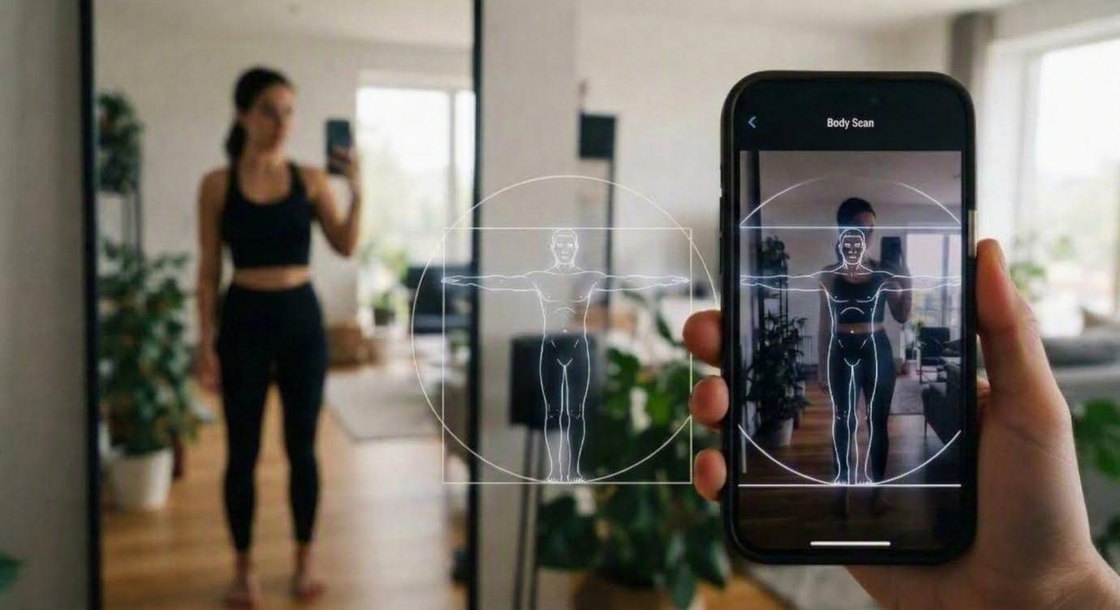
You've watched yourself move — in a mirror, in a race photo, in a video someone took. You have never once seen the shape you hold when nothing is happening. Which is the shape you're in for sixteen hours a day. Stand still in front of your phone, and Llyr draws it.
Illustration. The body under the read is an anatomical drawing, not a scan of anyone. Llyr reads where your joints sit — it does not see muscle, and no part of the figure is shaded by what the read found.
The shape you're in when nothing is happening.
Training is a couple of hours. The rest of the day is a desk, a car seat, a sofa, a bed — and the shape you hold through all of it is the one your body has quietly decided is normal.
That's usually where the one-sided stuff comes from. The shoulder that always aches on the same side. The hip that never quite frees up. The neck that goes after a long drive. None of it shows up in a session, because none of it started in one.
It's also the thing you're least equipped to check. A mirror is reversed and you correct for it the moment you look. A photo is one angle and a bad one. You have no way to see yourself the way someone standing across the room sees you.
What a still frame gives you.
How you stack Head over ribs, ribs over hips, hips over feet — and how far off the plumb line each one sits.
Side against side Shoulder against shoulder, hip against hip. The asymmetry you stopped noticing years ago, put in front of you.
The line of your spine The curve you hold standing, and how it changes when you sit down or lie flat.
Where your weight sits How your ankles, hips and shoulders stack against a vertical line — leaning forward, back, or loaded onto one side.
Anything turned away from the lens One camera sees one side. Rotation that happens in the axis pointing at the phone is invisible to it, so Llyr leaves it blank rather than putting a number on it.
Stand there. That's the whole capture.
No sensors, no markers, nothing to strap on. The hardest part is remembering to stand still.
01 Prop the phone up
Waist height, a couple of paces back, square to you. Against a water bottle or a wall works.
02 Stand how you normally stand
Not how you stand when someone's looking. Let your weight settle where it usually settles — that's the thing being read.
03 Turn a quarter and repeat
Front-on, then side-on. Two angles, because the plumb line means something different in each.
What this isn't.
This is a reading of geometry from one camera. It is not a diagnosis, it is not a physio, and it does not know why your shoulder sits where it sits — only that it does.
Llyr is deliberately narrow about this. It reports the shape it can see and the side-to-side differences it can measure. It does not name a condition, and where the view can't support a reading it leaves the line blank instead of filling it in.
If something hurts, that's a person's job, not a phone's.
See how you're actually standing.
Join the early-access list. Sign up here and the posture read is what you'll hear about.
No spam. Just an email when there's something to try.